How to Display 1000 Cranes (Senbazuru)

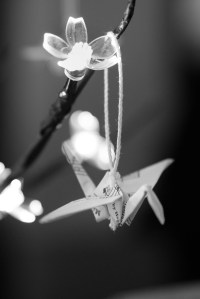
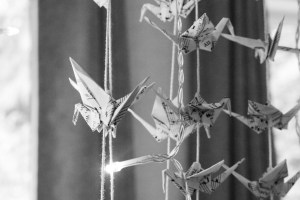
I was surprised to discover that folding one thousand origami cranes (senbazuru) for a wedding backdrop is easy, compared to trying to figure out a good way to display them after the event. The backdrop turned out beautifully, featuring 1000 cranes folded from hymn book paper and knotted onto bamboo strings of two lengths, interspersed with curtain lights, and topped with artificial greenery on a $30 white metal wedding stand from Hobby Lobby. Sure, it was a little flimsy, but nothing that white duct tape, zip ties, and artfully draped fabric couldn’t handle.

For several years afterward, the backdrop stood in front of a window in my son’s bedroom, serving as a much-loved night light. Eventually, the lights stopped working, but even stripped of its greenery and dusty fabric, bolted to the wall, with duct tape and zip ties on full display, I still loved the way the morning sun shone through the cranes. However, this clearly wasn’t a long-term display solution.

After some thought and research over the years, I identified several options, none of which I really liked that much:

Solution 1: Move the paper cranes onto a higher-quality backdrop stand and place against an empty wall.
Objection: We live in a small house and don’t have any spare walls.

Solution 2: Hang the cranes off a decorative branch.
Objection: The branch would have to be very large and I would have to untie and re-string all of the cranes in shorter lengths, which would be a lot of work (if it didn’t ruin them completely in the process). Also, I didn’t have any good wall space for the project.

Solution 3: The most common display method, where the origami cranes are stacked tightly on top of each other in thick strands.
Objection: This makes them look chunky and unappealing, in my opinion, and kills the magical effect of seeing them floating gently as the air moves.

Solution 4: Cutting the cranes off the strings and piling them in a shadow box or glass container.
Objection: Once again, this kills the magic and the container would have to be quite large.

Solution 5: Hang them across a doorway.
Objection: While this would look amazing, I believe they would not last long due to wear-and-tear on the paper.


What to do? I present to you, the spiral hanger!

I stumbled upon the spiral hanger (2 pack for $16.99) while browsing on Amazon and instantly knew I’d found the perfect solution to my crane problem. Originally designed to air dry large blankets or sheets, these spiral hangers provide an attractive, tangle-free, and space-efficient way to display 1000 paper cranes. They can even be easily pushed aside for access to the bookshelf behind them. It was definitely worth it to spray paint the hanger white and I would love to eventually add some lights and figure out a way to decorate the top (perhaps with faux cherry blossoms or greenery). If I ever have more space, I would even consider splitting the cranes in half to make two matching pillars.

These flash phone photos are not great due to the poor lighting in the room. In person, the cranes appear to float delicately in an appealing pillar that invites the eye and catches the light well. I wanted to share this display idea for any one else who might need a little inspiration, especially since I haven’t seen anything else like it online. If you’ve folded one thousand origami cranes and come up with a unique way to display your senbazuru, I would love to hear about it!

The King of Diamonds

The King of Diamonds: The Search for the Elusive Texas Jewel Thief by Rena Pederson, 5/5

Pederson takes the reader on a ride-along as she investigates the most glamorous cold case imaginable: a brazen and idiosyncratic jewel thief who terrorized the fabulously wealthy of Dallas for a decade. Over seven years of research is condensed into a satisfying page-turner that weaves history, biography, and true crime together, while exploring the good, the bad and the ugly of 1950s and ’60s Dallas society, from the richest philanthropist to the shadiest gangster and everything in between.

Why I read it: I think I saw an author interview on social media and the story sounded fascinating.

Thames Mudlarking

Thames Mudlarking: Searching for London’s Lost Treasures by Jason Sandy and Nick Stevens, 3/5

I appreciated the abundant, high-quality photographs in this slim book, but the text was dry and uninspiring.

Why I read it: Amazon threw this gift for my mother-in-law into a box of other purchases, completely devoid of any wrapping, to be tumbled around like a river rock on its journey to my door. It arrived predictably battered around the edges, but the silver lining was that I was able to take advantage of the exchange window to read it for myself.

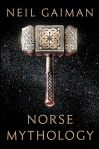
Norse Mythology

Norse Mythology by Neil Gaiman, 5/5

I am not a fan of Neil Gaiman’s work in general, but there is no denying the excellence of this retelling of tales from Norse mythology. The tone is fresh, without too much anachronism; sensitive and poetic, not melodramatic; and witty without flippancy.

Why I read it: my husband enjoyed the audiobook and I liked the bit that I overheard, so he bought a hard copy.

Bertram

Bertram; or, The Castle of St. Aldobrand by Charles Robert Maturin, 3/5

Drama is my least favorite literary genre and via ebook is my least favorite method of literary consumption, but my curiosity was adequately rewarded by this obscure, yet affectingly tragic and well-written play from the early 19th century, made available online by the University of Virginia Library.

Why I read it: A dramatic quote from this play, used as a chapter epigraph in The Hidden Hand, piqued my curiosity:
“By hell and all its host, he shall not live.
This is no transient flash of fugitive passion—
His death hath been my life for years of misery—
Which else I had not lived—
Upon that thought, and not on food, I fed,
Upon that thought, and not on sleep, I rested—
I come to do the deed that must be done—
Nor thou, nor sheltering angels, could prevent me.”

Von Ryan’s Express

Von Ryan’s Express by David Westheimer, 4/5

The movie portrayal of this suspenseful WWII prison escape story was a beloved family favorite at my house, growing up, and I’m embarrassed to admit my shock upon discovering, much later, that it did not in fact portray a true event, but was based on a work of historical fiction. Despite substantial differences between film and novel, I really enjoyed the latter’s believable personalities, exciting events, and overall tone of confident authenticity that no doubt can be attributed to the author’s firsthand POW experience.

Why I read it: A recommendation from my sister, who lent me her copy.

All That the Rain Promises and More…

All That the Rain Promises and More: A Hip Pocket Guide to Western Mushrooms by David Arora, 5/5

Don’t be fooled by the frankly insane cover photo and title–this helpful book is packed with color photographs and well-organized descriptions of the most common mushrooms found in the western United States, interspersed with additional info, poetry, recipes, and anecdotes collected from the mycophile community. Yes, it’s a little silly at times, but the author is deeply knowledgeable about the topic and I appreciate the sense of humor and passion that are reflected in this conveniently-sized book. I found the closing essay to be particularly compelling on the topic of over-regulation of hunting/gathering activities:

“In other words, the largely urban-suburban vision of nature as a beautiful, peaceful refuge from the stresses and conflicts of civilization, is in fundamental conflict with the rural or less “civilized” perception of nature as a provider of sustenance and wealth. Therein lies a great irony: it is the cities that suck food, energy, and resources from the landscape, yet there is a long and tragic history of industrial and agricultural peoples persecuting “savage” outsiders (in the most literal sense of the word) who hunt and gather (253).”

“No doubt the admonition to “take only photographs, leave only footprints,” is desirable in certain sensitive or pristine areas. But it is inappropriate in most situations because it is a fundamental denial of who we are: creatures of the earth whose most ancient heritage (or birthright, if you will) is foraging for food in the forest.
This enforced separation of human being from the natural world can only undermine support for the public acquisition and protection of habitat. The more we view the forests and fields as a resource […] the more likely we are to cherish that resource (254).”

Why I read it: I find mushrooms fascinating and love to spot them around the yard.

The Hidden Hand

The Hidden Hand by Mrs. E.D.E.N. Southworth, 3/5

I was annoyed to realize, after finishing this novel, that I had already read and reviewed it fourteen years ago! Interestingly, I felt pretty much the same about it this time around as I did before. However, this vintage edition was more pleasant than the previous one and did not contain so many italics. There was still an unusual (one might say, excessive) amount of exclamation points, but they did not rankle like before. Perhaps I am mellowing grammatically as the years go by.

Why I read it: a recommendation and loan from my sister.

My Favorite Intermissions

My Favorite Intermissions: Lives of the Musical Greats and Other Facts You Never Knew You Were Missing by Victor Borge and Robert Sherman, 5/5

I half-expected this collection of loosely opera-themed musical anecdotes to be outdated and cringey, but I was so wrong. The passage of time and changing tastes have not dampened Borge’s trademark hilarity.

Why I read it: I loved watching Victor Borge on VHS as a child and this book was a welcome thrift store find.

The Perfect Guide to Sumo

The Perfect Guide to Sumo in Japanese and English by Katsuharu Ito, translated by David Shapiro, 4/5

This small book on a large topic is packed with minuscule text and beautiful, historic artwork. I wish it were available in a larger, better edited format that would do justice to the informative dual-language text and generous illustrations.

Why I read it: my husband and I are fans of sumo.